
Odoo ERP is an open-source enterprise resource planning platform that enables organizations to manage and integrate essential business operations through a unified suite of applications. It connects key business areas such as accounting, customer relationship management (CRM), sales, inventory, manufacturing, human resources, project management, and eCommerce within a centralized system.
At SK Technology, Odoo ERP is explored as a modern business management framework that demonstrates how integrated enterprise applications can streamline workflows, improve data visibility, and support digital transformation. The platform follows a modular architecture, allowing organizations to adopt specific applications based on their operational requirements while maintaining a connected flow of business information.
Unlike traditional software systems that operate as isolated tools, Odoo ERP uses interconnected modules that share data across departments in real time. Its flexible framework, built with technologies such as Python, PostgreSQL, XML, and web-based components, enables customization, integration, and scalability for different organizational environments.
This guide explains what Odoo ERP is, how its architecture functions, the major Odoo modules, its technical foundation, business applications, advantages, challenges, and the role of integrated ERP systems in modern business management.
What Is Odoo ERP?
Odoo ERP represents a modern approach to business management by connecting organizational processes through a flexible and integrated application framework. It is designed to help businesses manage information, coordinate operations, and improve process efficiency through interconnected enterprise applications.
Definition and Core Purpose of Odoo ERP
The core purpose of Odoo ERP is to create a unified system where different business activities can operate together through shared processes and structured data. It helps organizations manage workflows across departments by providing applications that support areas such as finance, customer management, operations, and resource planning.
Odoo follows a modular design, allowing businesses to adopt the applications they need while maintaining connections between different operational areas. This approach helps reduce information gaps, improve process coordination, and provide better visibility into business activities.
How Odoo Became a Popular ERP Platform
Odoo gained popularity through its evolution from TinyERP to OpenERP and later Odoo, expanding from a simple ERP application into a broader business management ecosystem. Its growth was influenced by its open-source model, active developer community, flexible framework, and extensive collection of business applications.
The platform’s ability to support customization, third-party integrations, and different business workflows helped it become a widely recognized ERP solution. The availability of Odoo Community Edition and Odoo Enterprise Edition further expanded its adoption among organizations with different technical and operational requirements.
How Does Odoo ERP Work?
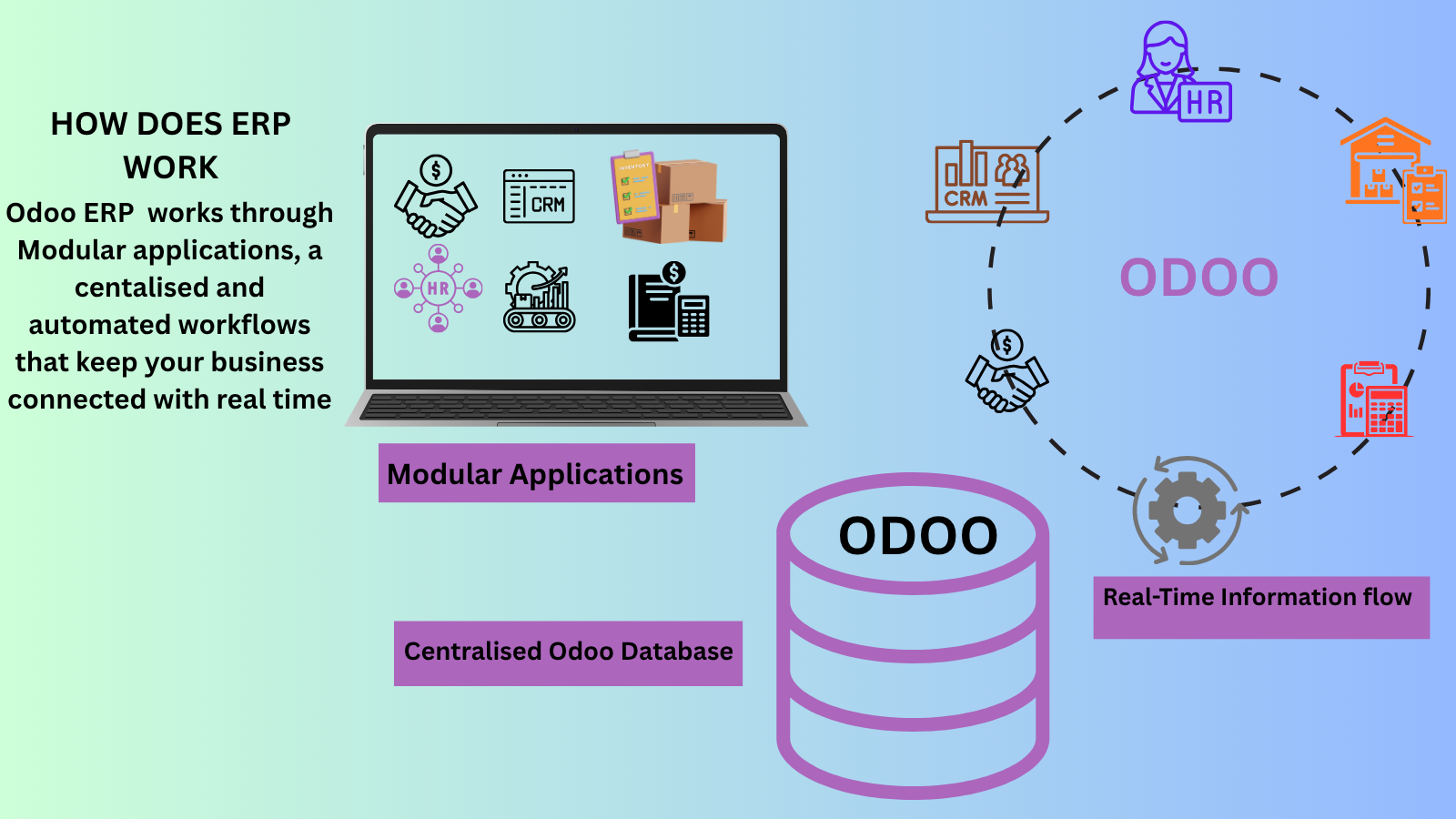
Odoo ERP works through a combination of modular applications, a shared database structure, and automated workflows that allow different business processes to operate as a connected system. Instead of managing separate software for each department, Odoo links operational data and processes across the organization.
Modular ERP Architecture
Odoo uses a modular ERP architecture where each business function is handled through dedicated applications called Odoo modules. These modules are built on the same framework, allowing organizations to add, remove, or customize applications based on their operational requirements.
How Odoo Modules Connect Business Operations
Odoo modules communicate with each other through shared data models and integrated workflows. For example, a customer order created in the Sales module can connect with inventory availability, delivery operations, and financial records in Accounting. This connection creates a continuous information flow between different business activities.
Centralized Database and Real-Time Information Flow
Odoo stores business records in a centralized PostgreSQL database, where information from different modules is managed through a common data structure. When users update records in one application, connected modules can access the updated information, improving data consistency and reducing duplicate entries.
This centralized approach supports real-time reporting, cross-department collaboration, and better visibility into business operations.
Workflow Automation in Odoo ERP
Odoo automates routine business activities by using configurable workflows, approval rules, scheduled actions, and automated triggers. Processes such as sales order management, invoice creation, inventory updates, employee requests, and manufacturing operations can be streamlined with fewer manual steps.
Through workflow automation, Odoo helps organizations create structured processes that improve operational control and reduce repetitive administrative tasks.
What Are the Main Modules of Odoo ERP?
Odoo ERP is organized into a collection of specialized applications known as modules, where each module manages a specific business function while remaining connected through the overall ERP framework. These modules allow organizations to manage customer interactions, financial operations, resources, production, and internal processes within a unified system.
Odoo CRM and Sales Management
The Odoo CRM module helps businesses manage customer relationships, sales opportunities, leads, and communication activities. It provides tools for tracking the customer journey, managing sales pipelines, and organizing interactions between sales teams and customers.
The Odoo Sales module supports quotation management, sales orders, pricing rules, and order processing by connecting customer demand with other business operations.
Odoo Accounting and Financial Management
The Odoo Accounting module manages financial activities such as invoicing, payments, bank reconciliation, expense tracking, and financial reporting. It connects financial data with other modules, allowing transactions from sales, purchases, and operations to flow into accounting records.
Odoo Inventory and Supply Chain Management
The Odoo Inventory module manages stock movements, warehouse operations, product tracking, and supply chain activities. It supports features such as inventory forecasting, automated replenishment, barcode operations, and real-time stock visibility across locations.
Odoo Manufacturing (MRP)
The Odoo Manufacturing (MRP) module helps organizations manage production processes, including bills of materials (BOM), work orders, manufacturing planning, and quality control. It connects production activities with inventory, purchasing, and resource planning.
Odoo Human Resource Management
The Odoo HR module supports employee-related processes such as employee records, recruitment, attendance, leave management, appraisals, and payroll-related operations. It provides a structured system for managing workforce information.
Odoo Project Management
The Odoo Project Management module helps teams organize projects, tasks, deadlines, timesheets, and collaboration activities. It provides visibility into project progress and connects project operations with invoicing, customer management, and employee workflows.
What Makes Odoo Different From Traditional ERP Systems?
Odoo stands out from traditional ERP systems because of its open-source foundation, modular design, and flexible customization options. Instead of using a fixed ERP structure, Odoo allows organizations to select required applications, adapt workflows, and expand functionality as their business needs change.
Open-Source ERP Approach
Odoo’s open-source model provides flexibility for developers and organizations to customize and extend the platform according to specific requirements.
Modular Business Applications
Odoo uses separate but connected applications, allowing businesses to implement modules such as CRM, accounting, inventory, and manufacturing based on their operational needs.
Customization and Scalability
With its flexible framework, Odoo supports custom modules, integrations, and workflow adjustments, making it adaptable for different business sizes and evolving processes.
Who Uses Odoo ERP?
Odoo ERP is used by organizations across different industries because of its flexible modules and ability to support various business processes. Its adaptable structure allows companies to choose applications based on their operational requirements.
Small and Medium-Sized Businesses
SMBs use Odoo to manage essential functions such as sales, accounting, inventory, and customer management within a connected system.
Manufacturing Organizations
Manufacturing companies use Odoo for production planning, inventory control, supply chain management, and manufacturing resource planning (MRP).
Service-Based Companies
Service businesses use Odoo to manage projects, customer relationships, timesheets, invoicing, and internal workflows.
Enterprise Organizations
Larger organizations use Odoo for integrated business operations, customized workflows, multi-department management, and scalable ERP capabilities.
What Are the Benefits of Using Odoo ERP?
Odoo ERP helps organizations improve business management by connecting processes, centralizing information, and reducing manual operations. Its integrated framework enables better coordination between departments and supports more informed decision-making.
Improved Business Process Integration
Odoo connects different business functions through integrated modules, allowing processes such as sales, inventory, accounting, and customer management to work together within one system.
Better Data Visibility
With a shared database and real-time information access, Odoo provides clearer visibility into business operations, helping teams monitor activities, generate reports, and make data-driven decisions.
Increased Operational Efficiency
By automating repetitive tasks and streamlining workflows, Odoo helps reduce manual effort, improve process consistency, and optimize daily business operations.
What Are the Challenges of Implementing Odoo ERP?
Implementing Odoo ERP requires proper planning, technical understanding, and organizational readiness. While the platform offers flexibility, businesses need to carefully manage requirements, customization, and user adoption to achieve effective results.
Planning and Requirement Analysis
A clear understanding of business processes, goals, and required modules is essential before implementation. Poor requirement analysis can lead to selecting unnecessary features, workflow issues, or an ERP structure that does not match operational needs.
Customization Management
Odoo’s flexible framework allows customization, but excessive modifications can increase complexity, maintenance requirements, and upgrade challenges. Organizations need to balance standard Odoo functionality with necessary custom developments.
User Adoption and Training
Successful ERP adoption depends on how effectively users understand and apply the system. Proper training, process alignment, and user involvement help employees adapt to new workflows and use Odoo features efficiently.
Odoo ERP Architecture and Technology Stack
Odoo ERP is built on a flexible web-based architecture that combines application frameworks, database management, and integration technologies to support business applications, customization, and scalable operations.
Programming Languages and Frameworks
Odoo is primarily developed using Python for its backend logic and business models, along with XML, JavaScript, and web technologies for user interfaces and application development. Its modular framework allows developers to create and extend Odoo applications.
Database Structure
Odoo uses PostgreSQL as its relational database management system. The database stores business records, configurations, user permissions, and transactional data while allowing different modules to access connected information through a shared data model.
APIs and Integrations
Odoo supports integration with external systems through APIs (Application Programming Interfaces) and web services. These integrations allow businesses to connect Odoo with platforms such as payment gateways, eCommerce systems, third-party applications, and other enterprise software.
Frequently Asked Questions About Odoo ERP
1. What is Odoo ERP?
Odoo ERP is an open-source enterprise resource planning platform that integrates business functions such as accounting, CRM, sales, inventory, and HR into one system.
2. Is Odoo an ERP system?
Yes, Odoo is a modular ERP system designed to manage and connect different business operations through integrated applications.
3. How does Odoo ERP work?
Odoo works through connected modules, a centralized database, and automated workflows that allow real-time information sharing across departments.
4. What modules are available in Odoo ERP?
Odoo provides modules for CRM, Sales, Accounting, Inventory, Manufacturing, Human Resources, Projects, eCommerce, and more.
5. Is Odoo open-source software?
Yes, Odoo has an open-source Community Edition, along with an Enterprise Edition that includes additional features and services.
6. Who uses Odoo ERP?
Odoo is used by small businesses, manufacturing companies, service providers, and large organizations across different industries.
7. What programming language does Odoo use?
Odoo is mainly developed using Python, with PostgreSQL as its database and web technologies for its interface.
8. What makes Odoo different from traditional ERP systems?
Odoo differs through its modular structure, open-source approach, and ability to customize applications according to business requirements.