
Odoo vs SAP ERP: Complete Comparison of Features, Cost, Implementation, and Business Fit
SK Technology’s Odoo vs SAP ERP: Complete Comparison of Features, Cost, Implementation, and Business Fit provides an in-depth comparison of two widely used enterprise resource planning (ERP) systems, Odoo ERP and SAP ERP. The article explains how both platforms differ in their architecture, modules, licensing models, customization options, implementation complexity, scalability, integrations, and industry applications.
This guide helps business owners, ERP decision-makers, IT managers, and technology professionals understand the strengths, limitations, and suitability of Odoo and SAP ERP for different business environments. It covers key areas including finance, CRM, inventory management, manufacturing, human resources, reporting, automation, and ERP migration considerations to support better ERP evaluation and selection decisions.
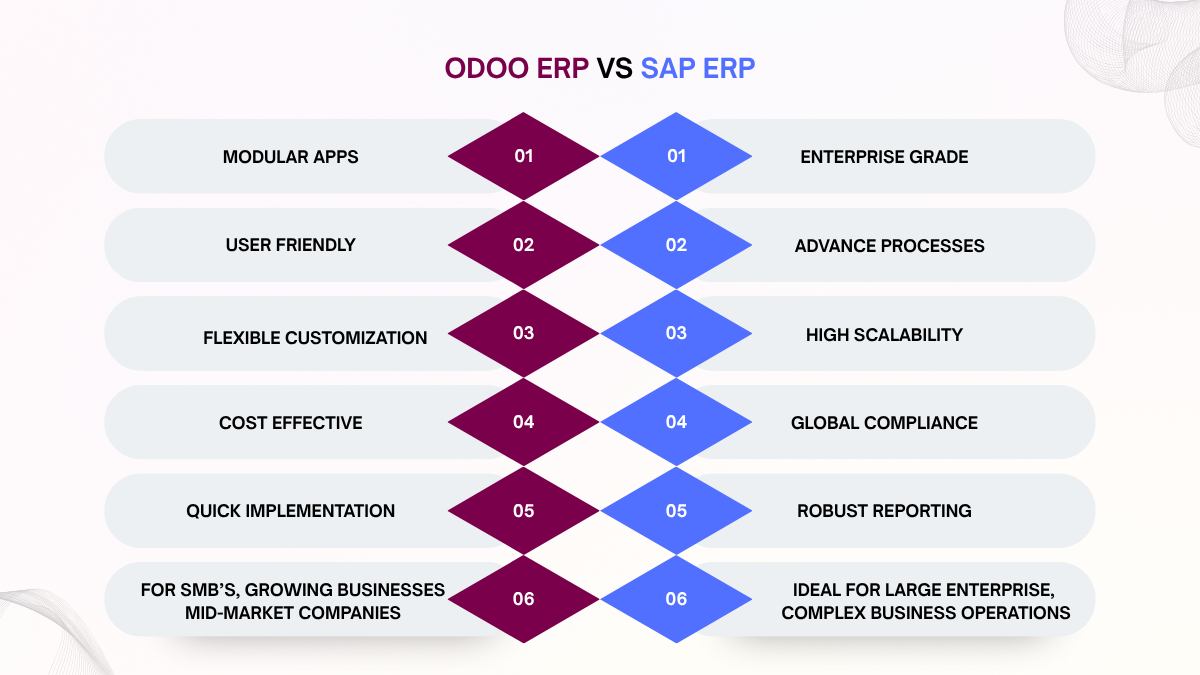
Understanding Odoo ERP and SAP ERP
What Is Odoo ERP?
Odoo ERP is a modular enterprise resource planning platform that combines business applications such as accounting, CRM, inventory, manufacturing, HR, and e-commerce into one integrated system. Its flexible architecture allows businesses to select required modules and customize workflows based on their operational needs.
Odoo Architecture and Modular Approach
Odoo uses an app-based structure where individual business functions work as connected modules through a shared database. This modular design enables organizations to expand functionality as their business grows.
Odoo Community vs Enterprise Editions
- Odoo Community Edition: Open-source version with core ERP features and community-driven development.
- Odoo Enterprise Edition: Paid version with additional applications, advanced features, official support, and enhanced business capabilities.
What Is SAP ERP?
SAP ERP is an enterprise resource planning ecosystem designed to manage complex business operations across finance, supply chain, manufacturing, human resources, and other enterprise functions. It is widely used by large organizations requiring structured processes and advanced scalability.
SAP S/4HANA Overview
SAP S/4HANA is SAP’s modern ERP platform built on the HANA in-memory database, providing real-time analytics, simplified processes, and support for large-scale enterprise operations.
SAP Business One Overview
SAP Business One is an ERP solution designed for small and medium-sized businesses, offering integrated management of accounting, sales, inventory, purchasing, and operational processes.
Odoo vs SAP ERP Feature Comparison
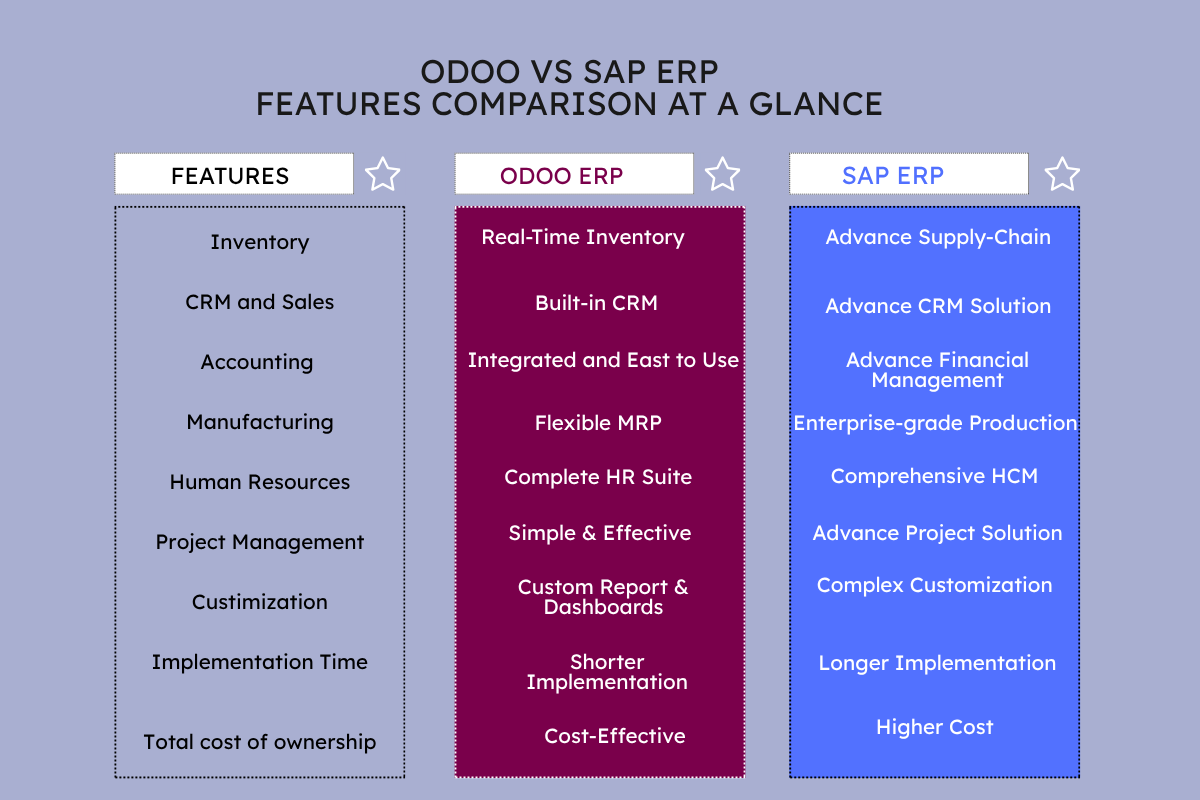
Odoo and SAP ERP provide a wide range of business management capabilities, but they differ in their approach. Odoo focuses on modular applications with flexible customization, while SAP provides enterprise-level solutions designed for complex business processes.
Accounting and Financial Management
Odoo Accounting provides integrated financial tools for invoicing, payments, expense tracking, budgeting, and reporting. Its modular structure allows businesses to manage financial operations alongside other business functions.
SAP ERP Finance offers advanced financial management capabilities, including financial accounting, controlling, compliance reporting, asset management, and enterprise-level financial planning.
CRM and Sales Management
Odoo CRM and Sales help businesses manage leads, opportunities, customer interactions, quotations, and sales workflows through an integrated platform.
SAP CRM and Sales solutions focus on managing complex sales processes, customer relationships, pricing structures, and large-scale enterprise sales operations.
Inventory and Warehouse Management
Odoo Inventory supports stock management, warehouse operations, barcode tracking, replenishment, and inventory forecasting with a user-friendly interface.
SAP Inventory and Warehouse Management provides advanced supply chain control, warehouse processes, material planning, and inventory management for complex operations.
Manufacturing and Production Planning
Odoo Manufacturing includes production planning, bills of materials (BOM), work orders, quality control, and maintenance management for growing manufacturing businesses.
SAP Manufacturing solutions support large-scale production environments with advanced planning, resource management, production control, and industry-specific manufacturing processes.
Human Resource Management
Odoo HR modules manage employee records, recruitment, attendance, leave management, payroll, and employee-related workflows.
SAP HR solutions provide enterprise human capital management features, including workforce planning, payroll, talent management, and global HR processes.
Project Management
Odoo Project Management helps teams manage tasks, timesheets, milestones, project budgets, and resource allocation within a connected ERP environment.
SAP Project Management supports complex enterprise projects with advanced planning, cost tracking, resource management, and integration with other business operations.
Reporting and Analytics
Odoo Reporting provides dashboards, operational reports, KPIs, and business insights across different modules through its integrated system.
SAP Analytics and Reporting delivers advanced enterprise analytics, real-time reporting, data visualization, and decision-support capabilities for large organizations.
Odoo vs SAP ERP Customization and Flexibility
Customization is an important factor when selecting an ERP system because businesses often need software that matches their unique workflows, industry requirements, and growth plans. Odoo focuses on modular flexibility, while SAP provides deep enterprise-level configuration and development capabilities.
Odoo Customization Approach
Odoo offers a flexible customization model through its modular architecture and open-source framework. Businesses can modify existing applications, create custom modules, automate workflows, and integrate third-party systems based on specific operational needs.
Key customization capabilities include:
- Custom Odoo modules and applications
- Workflow automation
- User interface modifications
- API-based integrations
- Industry-specific functionality extensions
Odoo’s modular approach allows organizations to start with essential applications and add new capabilities as business requirements evolve.
SAP Configuration and Development Approach
SAP customization focuses on configuring and extending enterprise processes to support complex organizational requirements. It provides powerful tools for modifying workflows, integrating systems, and developing industry-specific solutions.
Key SAP customization capabilities include:
- Advanced system configuration
- ABAP-based development
- SAP Fiori application extensions
- Enterprise integrations
- Industry-specific process customization
SAP’s approach is designed for organizations that require highly structured processes, regulatory compliance, and large-scale operational management.
Odoo vs SAP ERP Implementation Process
ERP implementation involves planning, configuring, customizing, migrating data, and preparing users for successful system adoption. Odoo and SAP follow similar implementation principles, but their complexity and approach differ based on business size, process requirements, and system architecture.
Odoo Implementation Stages
Odoo implementation typically follows a modular approach, allowing businesses to deploy required applications and expand functionality over time.
Requirement Analysis
The process begins by identifying business objectives, existing workflows, required modules, user roles, and integration needs.
Module Selection
Businesses select relevant Odoo applications such as accounting, CRM, inventory, manufacturing, HR, or project management based on operational requirements.
Configuration
The ERP system is configured by setting up company details, workflows, permissions, reports, and standard business processes.
Customization
Custom modules, workflow adjustments, and integrations are developed when standard Odoo functionality does not fully meet business requirements.
Testing
The configured system is tested to ensure workflows, data accuracy, integrations, and user requirements are working correctly.
Deployment
After approval, the system is launched, users are trained, and business operations transition to the new ERP environment.
SAP Implementation Stages
SAP implementation follows a structured enterprise approach designed to support complex business processes and large-scale operations.
Business Blueprint
Organizations document existing processes, define requirements, and create a detailed implementation roadmap.
System Configuration
SAP modules are configured according to business processes, industry requirements, and organizational structures.
Data Migration
Existing business data is cleaned, transformed, and transferred into the SAP environment while maintaining accuracy and consistency.
Testing
Extensive testing is performed to validate system functionality, integrations, workflows, and business scenarios.
Go-Live
The SAP system becomes operational after final validation, user preparation, and transition from existing systems.
Odoo vs SAP ERP Scalability Comparison
Scalability determines how well an ERP system can support business growth, increasing users, expanding operations, and evolving process requirements. Odoo provides flexible growth through modular expansion, while SAP is designed for large-scale enterprise operations with complex structures.
Which ERP Fits Growing Businesses?
Odoo ERP is well suited for growing businesses that need an adaptable system without adopting highly complex enterprise processes. Its modular architecture allows organizations to start with essential applications and add new functionalities such as CRM, accounting, inventory, manufacturing, and HR as their needs expand.
Key scalability advantages:
- Add new modules as business requirements grow
- Support multiple departments through one integrated platform
- Flexible customization for changing workflows
- Suitable for small and medium-sized businesses moving toward digital transformation
Which ERP Fits Large Enterprises?
SAP ERP is designed for large enterprises that manage complex operations, global processes, and extensive organizational structures. Its enterprise architecture supports advanced requirements such as multi-company management, international operations, regulatory compliance, and large-scale data processing.
Key scalability advantages:
- Supports complex global business environments
- Handles large volumes of transactions and users
- Provides industry-specific enterprise solutions
- Enables advanced supply chain, finance, and operational management
Odoo vs SAP ERP by Industry
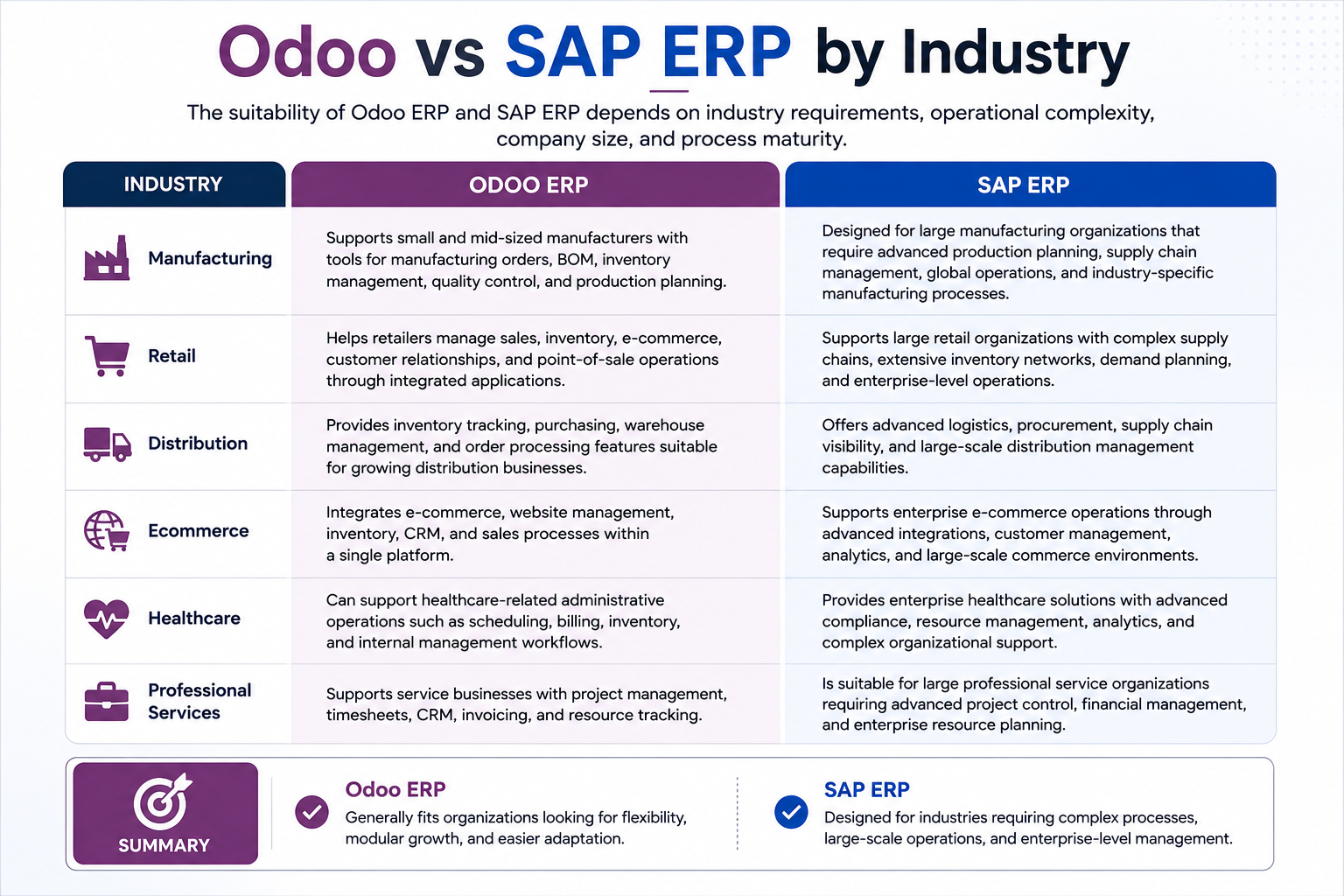
The suitability of Odoo ERP and SAP ERP depends on industry requirements, operational complexity, company size, and process maturity. Odoo is often preferred for flexible and modular business operations, while SAP is commonly used for complex enterprise environments requiring advanced industry processes.
Manufacturing
Odoo ERP supports small and mid-sized manufacturers with tools for manufacturing orders, bills of materials (BOM), inventory management, quality control, and production planning.
SAP ERP is designed for large manufacturing organizations that require advanced production planning, supply chain management, global operations, and industry-specific manufacturing processes.
Retail
Odoo ERP helps retailers manage sales, inventory, e-commerce, customer relationships, and point-of-sale operations through integrated applications.
SAP ERP supports large retail organizations with complex supply chains, extensive inventory networks, demand planning, and enterprise-level operations.
Distribution
Odoo ERP provides inventory tracking, purchasing, warehouse management, and order processing features suitable for growing distribution businesses.
SAP ERP offers advanced logistics, procurement, supply chain visibility, and large-scale distribution management capabilities.
Ecommerce
Odoo ERP integrates e-commerce, website management, inventory, CRM, and sales processes within a single platform.
SAP ERP supports enterprise e-commerce operations through advanced integrations, customer management, analytics, and large-scale commerce environments.
Healthcare
Odoo ERP can support healthcare-related administrative operations such as scheduling, billing, inventory, and internal management workflows.
SAP ERP provides enterprise healthcare solutions with advanced compliance, resource management, analytics, and complex organizational support.
Professional Services
Odoo ERP supports service businesses with project management, timesheets, CRM, invoicing, and resource tracking.
SAP ERP is suitable for large professional service organizations requiring advanced project control, financial management, and enterprise resource planning.
Summary:
Odoo generally fits organizations looking for flexibility, modular growth, and easier adaptation, while SAP is designed for industries requiring complex processes, large-scale operations, and enterprise-level management.
Can Businesses Migrate From SAP to Odoo?
Migrating from SAP ERP to Odoo ERP is possible when organizations need a more flexible, modular, or cost-effective ERP environment. The migration process requires careful planning to ensure business data, workflows, and operational processes are transferred correctly.
Migration Planning
The migration begins with analyzing the existing SAP environment, identifying required business processes, reviewing customizations, and defining the migration strategy. Organizations evaluate which SAP functionalities should be replaced, improved, or redesigned in Odoo.
Key considerations:
- Current SAP modules and workflows
- Business requirements
- Migration scope and timeline
- Data quality assessment
- Custom functionality review
Data Transfer
Data migration involves extracting, cleaning, transforming, and importing essential business information from SAP into Odoo. Proper validation ensures that critical records remain accurate after migration.
Common data categories include:
- Customer and vendor records
- Products and inventory data
- Financial information
- Sales and purchase history
- Employee records
Module Mapping
SAP modules need to be aligned with their equivalent Odoo applications to maintain business continuity. This process identifies how existing workflows and functionalities will operate in the new ERP system.
Examples:
- SAP Finance → Odoo Accounting
- SAP Sales and Distribution → Odoo Sales
- SAP Material Management → Odoo Inventory and Purchase
- SAP Human Resources → Odoo HR applications
User Training
Successful migration requires preparing employees to use the new ERP system effectively. Training focuses on new workflows, system navigation, role-based processes, and operational changes after migration.
Key training areas:
- Odoo interface and applications
- Updated business workflows
- User permissions and responsibilities
- New reporting processes
Summary:
SAP to Odoo migration involves strategic planning, accurate data transfer, functional mapping, and user adoption. A structured migration approach helps businesses transition smoothly while maintaining operational efficiency.
How to Choose Between Odoo and SAP ERP
Selecting between Odoo ERP and SAP ERP depends on business objectives, operational complexity, available resources, and future growth requirements. The right choice should be based on how well the ERP system aligns with current processes and long-term business needs.
Business Size
Business size is one of the key factors when evaluating ERP suitability.
- Odoo ERP is often suitable for startups, small and medium-sized businesses, and growing companies that need a flexible system with modular expansion.
- SAP ERP is commonly selected by large enterprises that require advanced processes, global operations, and complex organizational management.
Budget
ERP investment includes licensing, implementation, customization, training, integration, and ongoing maintenance.
- Odoo provides flexible licensing options and allows businesses to select required modules based on their needs.
- SAP generally requires higher investment due to its enterprise-level features, implementation complexity, and extensive customization requirements.
Complexity
The complexity of business operations influences ERP selection.
- Odoo works well for organizations looking for simpler deployment, adaptable workflows, and modular functionality.
- SAP is designed for businesses with complex operations, advanced compliance requirements, and sophisticated enterprise processes.
Industry Requirements
Different industries require different ERP capabilities.
- Odoo supports industries such as manufacturing, retail, e-commerce, distribution, and professional services through configurable applications.
- SAP provides industry-specific solutions for sectors with complex requirements, including large-scale manufacturing, global supply chains, and regulated industries.
Growth Plans
Future expansion should be considered when choosing an ERP platform.
- Odoo allows businesses to gradually add applications, users, and integrations as operations grow.
- SAP supports large-scale expansion, international operations, and complex business structures.
FAQs
1. What is the difference between Odoo ERP and SAP ERP?
Odoo focuses on modular flexibility and customization, while SAP ERP provides enterprise-level solutions for complex business operations.
2. Is Odoo better than SAP for small businesses?
Odoo is often suitable for small and medium-sized businesses due to its flexible modules and simpler adoption process.
3. Is Odoo cheaper than SAP ERP?
Odoo generally offers more flexible pricing, while SAP usually requires a higher investment due to its enterprise capabilities.
4. Can businesses migrate from SAP to Odoo?
Yes, businesses can migrate by planning data transfer, module mapping, testing, and user training.
5. Which ERP is more customizable, Odoo or SAP?
Odoo offers flexible module-based customization, while SAP provides advanced enterprise configuration and development options.